2026’s Newest Osteoporosis Injection Options
2026 brings clearer, more personalized ways to use osteoporosis injections—less guesswork, more intentional sequencing. This article explains the newest osteoporosis injection options in 2026 by name, including how denosumab, romosozumab, and anabolic daily injections typically work, how often they’re given, and what “transition planning” means when switching therapies. You’ll also see a practical comparison table, common monitoring and side-effect questions, and FAQs that reflect the real decisions people face when balancing fracture risk, dosing schedules, and coverage rules.
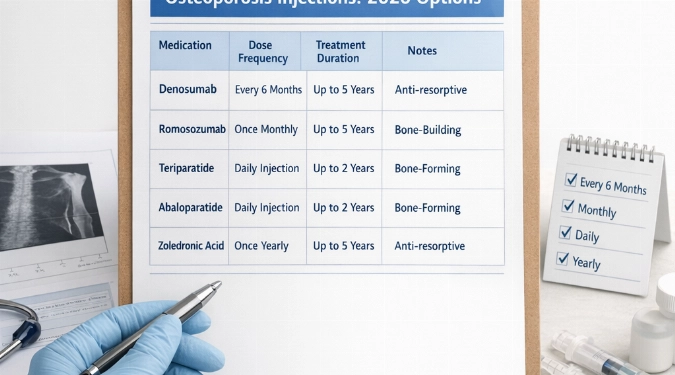
New injection choices for osteoporosis can feel like a lot to sort through—especially when you’re trying to understand what’s truly “new” in 2026 versus what’s simply being used more widely. Below is a clear, practical look at the newest osteoporosis injection options in 2026, how they work, and what questions to bring to a clinician.
What Counts As “Newest” In 2026
In 2026, “newest” usually means one of three things: a recently introduced drug, a newly expanded indication (who can use it), or a newly available formulation or dosing schedule that changes how injections fit into real life. For osteoporosis injections, the biggest story is not a flood of brand-new molecules every year—it’s how the current injectable classes are being positioned in better sequences (build bone first, then maintain), and how access and administration are improving.
The Four Core Injection Categories You’ll Hear About
Most injectable osteoporosis care still fits into four medication categories. The “new” part in 2026 is often which patients are being considered for each category and how clinicians combine or sequence them over time.
RANKL Inhibitor
Denosumab (brand name Prolia) is a twice-yearly injection that reduces bone breakdown by blocking RANKL, a key signal that activates osteoclasts (cells that resorb bone). In 2026 discussions, it’s commonly emphasized that timing matters: stopping denosumab without an appropriate transition plan may be associated with rapid bone loss and increased vertebral fracture risk, so clinicians often plan an “exit strategy,” frequently with a bisphosphonate.
Sclerostin Inhibitor
Romosozumab (brand name Evenity) is typically given monthly for one year. It has a dual effect—stimulating bone formation while also reducing bone resorption. In 2026, it’s often framed as a front-loaded option for people at very high fracture risk, followed by a maintenance therapy (commonly denosumab or a bisphosphonate) to hold onto gains.
Anabolic Parathyroid Hormone Pathway Injections
Teriparatide (Forteo) and abaloparatide (Tymlos) are daily self-injections that primarily build bone. They are usually time-limited therapies (often up to two years depending on product labeling and clinical context). A 2026 “newest options” conversation frequently includes practicality: training for self-injection, storage needs, and choosing candidates who can realistically adhere to daily dosing.
IV Antiresorptive Often Discussed Alongside Injections
Zoledronic acid (Reclast) is an intravenous infusion commonly given once yearly. While technically an IV infusion rather than a subcutaneous injection, it’s often grouped into the injectable conversation because it’s an administered option used to reduce bone resorption. In 2026 care pathways, it’s frequently discussed as a consolidation step after anabolic or denosumab therapy, depending on kidney function and overall risk profile.
Side Effects And Monitoring People Commonly Ask About
Injectables vary in what monitoring looks like. Denosumab and romosozumab often bring up calcium and vitamin D adequacy; clinicians may check calcium, vitamin D status, and kidney-related labs depending on the therapy. Anabolic agents can cause nausea, dizziness, or injection-site irritation in some people. Rare but serious topics sometimes discussed across antiresorptives include osteonecrosis of the jaw and atypical femur fractures—usually in the context of duration, dental health, and risk–benefit balance rather than as a reason for blanket avoidance.
A 2026 Comparison Table For Real-World Decision Making
| Option | Typical Schedule | Primary Effect | Common 2026 “Newest” Angle |
|---|---|---|---|
| Denosumab (Prolia) | Every 6 months | Decreases bone resorption | More emphasis on planned transition to avoid rebound bone loss |
| Romosozumab (Evenity) | Monthly for 12 months | Builds bone and reduces resorption | Used earlier for very high-risk patients, followed by maintenance therapy |
| Teriparatide (Forteo) | Daily self-injection | Builds bone | Sequencing: anabolic first, then antiresorptive “lock-in” therapy |
| Abaloparatide (Tymlos) | Daily self-injection | Builds bone | Candidate selection focused on adherence and fracture-risk urgency |
| Zoledronic acid (Reclast) | Yearly IV infusion | Decreases bone resorption | Consolidation after other injectables; kidney function is a key gatekeeper |
Access Questions People Are Asking In 2026
For many households, “option” also means “what can I actually receive through my coverage.” In 2026, injectable osteoporosis therapies are commonly influenced by prior authorization, step therapy (trying one category before another), site-of-care rules (clinic-administered vs home self-injection), and documentation of fracture risk (DXA results, prior fragility fractures, or clinical risk tools). If you’re building your own learning plan, an osteoporosis online course can help you understand these terms so you can read coverage letters and clinician notes with less confusion.
Global Research Threads That Shape 2026 Conversations
Even if your care is local, global data influences guidelines and clinical confidence. Large population studies on osteoporosis in china continue to add clarity on fracture patterns and aging-related risk at scale, while osteoporosis research increasingly contributes real-world evidence on adherence, vitamin D status, and cost-sensitive treatment pathways. Separately, the awareness and knowledge of osteoporosis among saudi females in riyadh is often discussed in public-health literature as an example of how education, screening access, and cultural context affect early detection—an important reminder that injectable innovations work best when paired with timely diagnosis.
FAQs About Newest Osteoporosis Injections In 2026
Are the newest injection options meant to replace calcium, vitamin D, and exercise?
Typically, no. Injections target bone remodeling pathways, while calcium/vitamin D adequacy and resistance/impact training support the “materials and signals” bones rely on. Clinicians often consider them complementary, with supplements and movement forming a baseline and injections used when fracture risk warrants medication-level benefit.
Is it safer to start with a bone-building injection or an antiresorptive injection?
It depends on fracture risk, past fractures, bone density scores, and other health factors. A common 2026 strategy is anabolic-first (teriparatide, abaloparatide, or romosozumab where appropriate) for very high-risk patients, then an antiresorptive to maintain gains. Others may start directly with an antiresorptive if risk is moderate or if an anabolic agent isn’t a fit.
What happens if someone misses an injection window?
The answer varies by drug. Some therapies are sensitive to delayed dosing, and clinicians may create catch-up plans to reduce the chance of losing protection. This is especially important to discuss ahead of time for medications where stopping or delaying can lead to faster bone turnover.
Do injections work the same for men and women?
Many injectable therapies are used in both men and women with osteoporosis, but eligibility can vary by labeling and by insurer criteria. Clinicians consider the underlying cause of bone loss (age-related, steroid-induced, endocrine-related) and individual fracture risk when matching a person to an injectable option.
Conclusion
2026’s newest osteoporosis injection options are best understood as a set of specific injectable categories—RANKL inhibition, sclerostin inhibition, anabolic daily injections, and administered antiresorptives—paired with smarter sequencing and closer attention to transition planning. Knowing the names, schedules, and “why this option now” logic can help you have a calmer, more productive conversation about what fits your risk level and your life.
Disclaimer: The information provided in this article is for educational and informational purposes only. It does not constitute professional advice. Readers should conduct their own research and consult with qualified professionals before making any decisions.