Offshore Agencies Guide: Structure, Services, and Key Benefits
For US businesses seeking to scale efficiently while controlling operational costs, partnering with offshore agencies has become a strategic necessity rather than just a cost-cutting measure. This guide dissects the operational framework of these agencies, detailing exactly how they function, the specific offshore agency services they provide, and the tangible benefits they offer.
Understanding the Structure of Offshore Agencies
The term “offshore agency” covers several distinct operational models, each designed to handle different levels of liability and management. To effectively leverage these partners, you must understand their structural differences.
Employer of Record (EOR) Structure In this model, the offshore agency acts as the legal employer of your remote staff. They handle all local compliance, payroll taxes, benefits, and HR legalities in the foreign country. You retain day-to-day management control over the employee’s tasks, but the agency absorbs the administrative burden. This is the most common structure for US companies wanting dedicated full-time staff without establishing a legal foreign entity.
Managed Services (BPO) Structure Under a Business Process Outsourcing (BPO) structure, the agency manages both the staff and the outcomes. You do not direct individual employees; instead, you contract the agency to deliver specific results, such as “handle 5,000 customer support tickets per month.” The agency handles training, quality assurance, and shift scheduling internally.
Staff Augmentation Structure This structure is a hybrid where the agency supplies skilled professionals to fill gaps in your existing onshore team. These specialized contractors work alongside your internal staff for specific projects, such as a software migration or a seasonal marketing push, often for a defined period.
Core Offshore Agency Services and Duties
Modern offshore agencies have moved far beyond simple call centers. They now provide highly specialized roles across various industries. When evaluating partners, you will typically find services categorized into these high-demand verticals:
Information Technology and Development Agencies provide access to a vast talent pool of technical experts. Common roles include Full Stack Developers (specializing in Python, Java, or React), QA Testers for automated software debugging, and DevOps engineers to manage cloud infrastructure.
Administrative and Back-Office Support This category includes Virtual Assistants (VAs) who handle calendar management and email correspondence, as well as specialized roles like Data Entry Specialists for CRM management and Bookkeepers proficient in US-standard software like QuickBooks or Xero.
Customer Support and Sales Agencies offer 24/7 coverage for Tier 1 and Tier 2 customer support via chat, email, and phone. They also provide Sales Development Representatives (SDRs) to handle lead qualification and outbound appointment setting during US business hours.
Digital Marketing and Creative Services here include SEO Specialists to manage on-page optimization, Content Writers for blog and copy production, and Graphic Designers for visual assets.
Key Benefits of Partnering with Offshore Agencies
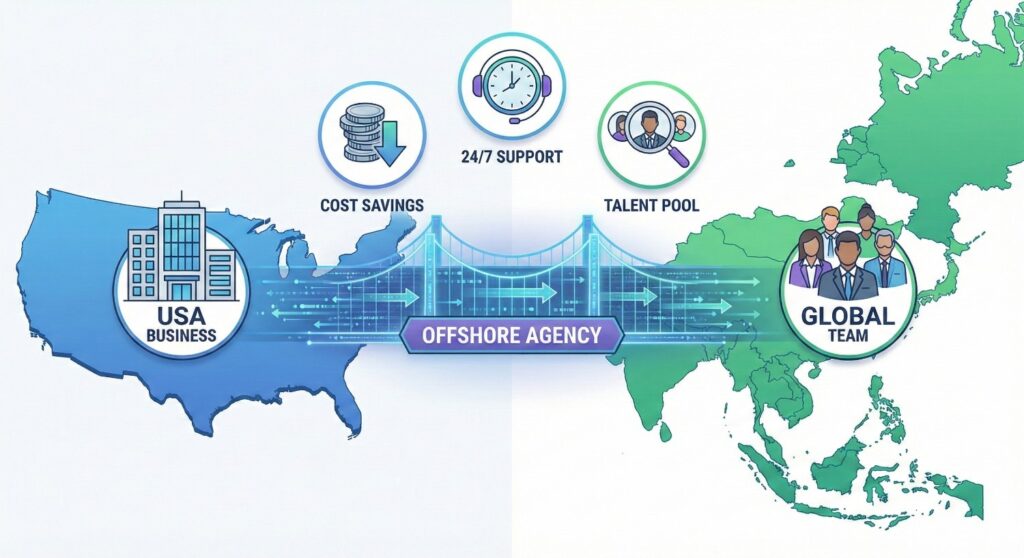
The decision to hire offshore staffing agencies US businesses trust is often driven by three primary advantages that directly impact the bottom line and operational efficiency.
Significant Cost Efficiency The most immediate benefit is labor cost arbitrage. By hiring through offshore agencies in regions like Southeast Asia, Eastern Europe, or Latin America, US companies typically reduce labor costs by 40% to 70% compared to domestic hiring. This includes savings on salaries, benefits, office space, and equipment.
Rapid Scalability Offshore agencies maintain a “bench” of pre-vetted talent. While hiring a local senior developer might take 3-4 months in a competitive US market, an offshore agency can often present qualified candidates within 1-2 weeks, allowing businesses to scale teams up or down rapidly based on project demands.
24/7 Operational Cycles By utilizing teams in different time zones, businesses can achieve a “follow-the-sun” workflow. Your US team can hand off tasks at 5 PM EST to an offshore team just starting their day, ensuring projects progress overnight and reducing turnaround times by half.
Strategic Offshore Agencies Selection
Successful offshore agencies selection requires a rigorous vetting process. Do not simply choose the cheapest provider.
- Verify Security Protocols: Ensure the agency complies with international data standards like GDPR or SOC 2, especially if they handle sensitive customer data.
- Test Communication Skills: During the interview process, assess English proficiency and cultural fit to ensure seamless integration with your US team.
- Check Track Records: Request case studies specifically from other US clients in your industry to verify their ability to deliver quality at your required scale.
Frequently Asked Questions
Is it legal for US companies to hire through offshore agencies? Yes, it is entirely legal. When you work with an agency, you are typically signing a B2B service contract with the agency itself (often a US-registered entity or a compliant international one), which simplifies the legal process compared to hiring foreign independent contractors directly.
How do offshore agencies handle time zone differences? Most reputable agencies offer “shift flexibility.” They can recruit staff willing to work US business hours (e.g., EST or PST shifts) or establish overlapping hours (e.g., 4 hours of overlap) to facilitate meetings and collaboration before the offshore team continues independently.
What is the typical cost of an offshore agency service? Costs vary by role and region, but a typical model involves a monthly fee that covers the employee’s salary plus the agency’s management fee. For example, a dedicated mid-level software developer might cost between $2,500 and $4,500 per month total, whereas a general administrative assistant might range from $1,200 to $2,000 per month.
Conclusion
Navigating the world of offshore companies requires a clear understanding of the landscape. By recognizing the distinct structures—from EOR to managed services—and identifying the specific offshore agency services that align with your needs, you can unlock substantial growth. The key benefits of cost savings, 24/7 productivity, and scalability make these partnerships a powerful tool for modern US businesses. With careful offshore agencies selection and a strategic approach to integration, you can build a resilient, global workforce that drives your company forward.