
Old Baseball Cards: Potential Goldmine in Plain Sight?
Have you ever stumbled upon a dusty shoebox of old baseball cards in your attic or basement? Many of us have, and it often sparks a simple question: are any of these actually valuable? While most childhood collections hold more sentimental value than financial worth, there are rare instances where a single piece of cardboard can be worth a fortune. This guide walks you through the specific factors that determine the value of old baseball cards and highlights the famous “holy grail” cards that collectors dream of discovering.
What Makes a Baseball Card Valuable?
Before analyzing specific examples, it is helpful to understand the key factors that determine a card’s worth. It is not just about age. The value of old baseball cards is a combination of four main elements: the player, the card’s rarity, its condition, and historical significance.
- The Player: Cards featuring legendary Hall of Fame players like Babe Ruth, Mickey Mantle, or Honus Wagner are almost always in high demand. A player’s rookie card is typically their most valuable.
- Rarity: How many were printed? How many have survived over the decades? Some cards are valuable simply because very few exist, either due to limited initial print runs or because they were discarded by mothers cleaning out bedrooms in the 1950s.
- Condition: This is one of the most critical factors. Professional grading companies like Professional Sports Authenticator (PSA) or Sportscard Guaranty Corporation (SGC) assess cards on a scale of 1 to 10. They look at the sharpness of the corners, the centering of the image, the quality of the edges, and the clarity of the surface. A pristine, perfectly preserved card can be worth hundreds or even thousands of times more than the exact same card with worn corners and creases.
- Significance: Does the card represent a major milestone? Is there a famous error on the card? For example, the 1990 Fleer Frank Thomas card with his name missing on the front is a well-known error card that collectors seek out.
Iconic Vintage Cards That Could Be Worth a Fortune
The question remains: Do you own any of these specific treasures? While the odds of finding one of these “holy grail” cards are slim, they represent the pinnacle of the hobby. Here are some of the most famous vintage baseball cards that command astronomical prices.
The 1909-1911 T206 Honus Wagner
Often called the Mona Lisa of baseball cards, this is one of the most valuable sports cards in the world. Honus Wagner was a superstar shortstop for the Pittsburgh Pirates, but he was famously against tobacco use. The card was produced and distributed by the American Tobacco Company in cigarette packs.
The story goes that Wagner demanded the company stop producing his card, as he did not want children to buy tobacco products to get his picture. Because of this, production was halted almost immediately, leaving only a tiny number of cards in circulation. It is estimated that fewer than 60 authenticated copies exist today.
- What to look for: A portrait of Honus Wagner in his Pirates uniform against a bright orange background. The back will have an advertisement for a brand like Piedmont or Sweet Caporal cigarettes.
- Value: A high-grade example sold for over $7 million. Even poor-condition copies are worth over a million dollars.
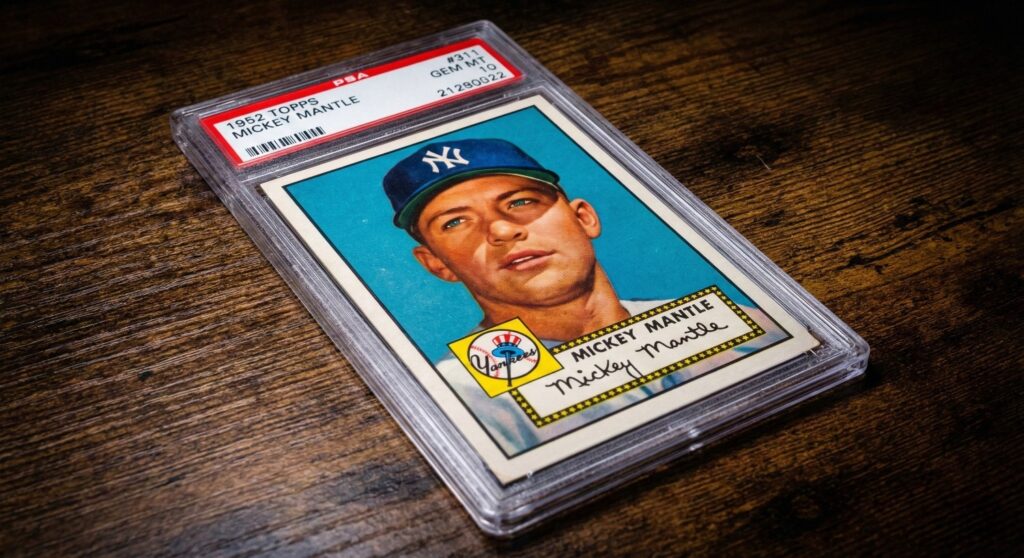
The 1952 Topps Mickey Mantle #311
This is perhaps the most iconic post-war baseball card. While it is not Mickey Mantle’s official rookie card (that was the 1951 Bowman), it is his first Topps card and is part of one of the most celebrated baseball card sets ever made.
Its rarity is the result of a fascinating business decision. The 1952 Topps set was released in several series throughout the year. The Mantle card was part of the final, high-number series. When sales slowed down in the fall, Topps found itself with a massive surplus of unsold cases. In 1960, to clear warehouse space, the company famously dumped thousands of these cards, including many Mantles, into the Atlantic Ocean.
- What to look for: A vibrant, colorized photo of a young Mickey Mantle looking over his right shoulder, bat in hand. The card has a blue background, a yellow facsimile signature, and the New York Yankees logo.
- Value: A mint condition PSA 10 example sold for $12.6 million in 2022. Lower-grade examples can still fetch tens or even hundreds of thousands of dollars.
The 1933 Goudey Babe Ruth #53
The 1933 Goudey set is legendary among collectors for its beautiful artwork and star-studded checklist. The set includes four different Babe Ruth cards, but card #53, featuring a full-body portrait of Ruth swinging a bat against a bright yellow background, is the most sought-after. Babe Ruth was the biggest star in sports, and this card captures his larger-than-life persona. It is a cornerstone of any serious vintage collection.
- What to look for: A full-length painting of Babe Ruth in his follow-through swing pose. The background is a solid, vibrant yellow.
- Value: A mint condition example sold for over $4 million. Even cards in good condition can be valued in the hundreds of thousands.
The 1954 Topps Hank Aaron #128
This is the official rookie card of “Hammerin’ Hank” Aaron, one of the greatest home run hitters of all time. The 1954 Topps set is known for its clean design, featuring a large player portrait and a smaller action shot. As the debut card of an inner-circle Hall of Famer, its value has steadily climbed over the years. It is a must-have for collectors who focus on the stars of the 1950s.
- What to look for: An orange background with a portrait of a very young Hank Aaron. Below the portrait is a smaller black-and-white image of a player sliding.
- Value: High-grade examples of this card can sell for over $350,000, with mid-grade cards often selling for tens of thousands.
What Should You Do If You Find Old Cards?
If you discover a collection, handle the cards with care. The oils on your hands can damage the surface. Hold them by the edges.
- Identify Them: Use online resources like the PSA CardFacts database to identify the year, manufacturer (like Topps, Bowman, or Goudey), and player.
- Assess the Condition: Be honest about the condition. Are the corners sharp or rounded? Are there creases? Is the picture centered?
- Consider Professional Grading: If you believe you have a potentially valuable card, the only way to realize its full market value is to have it professionally authenticated and graded. Companies like PSA, SGC, and Beckett (BGS) are the industry standards
Frequently Asked Questions
What does “vintage” mean for baseball cards? Generally, cards produced before 1980 are considered vintage. The period from the late 1980s through the mid-1990s is often called the “junk wax era” because companies overproduced cards, making most of them not very valuable today.
Are all old cards valuable? No, not at all. The vast majority of old cards are common player cards with little monetary value. Value is concentrated in the rookie cards of Hall of Fame players, rare error cards, and cards in exceptionally high-grade condition.
Where can I sell old baseball cards? Major auction houses like Heritage Auctions or Goldin are the best places to sell high-end, six-figure cards. For cards worth a few hundred or thousand dollars, online marketplaces like eBay are a popular option, especially for cards that have been professionally graded.
Conclusion
Whether you are a seasoned collector or just someone wondering if that box in the garage is a treasure chest, understanding the market is key. While not every card is a T206 Wagner or a 1952 Mantle, checking your collection for these baseball cards old icons could be a life-changing event. Take the time to identify, grade, and properly sell old baseball cards to ensure you get the maximum return on your history.